Food in Space
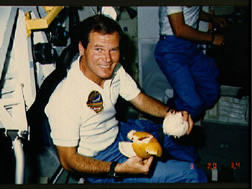
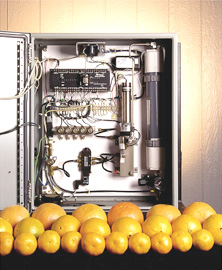
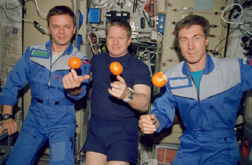
You have probably all seen the Discovery Channel and other reports talking about the food we eat out here. Foil pouches and the like. There have been several reasons to "disguise" this from the public, reasons I cannot reveal here, and quite frankly, its not my area. However now that you are up here on your way to the Moon or other destinations we can show you a little... In the last shipment alone we received over a half ton of fresh fruits and vegetables. They don't keep long here so we need to move them 'down the line' quickly, but as you can see by the crew, oranges and grapefruits are a big hit up here.
I watched the Hi-Def 30 minute broadcast of an "interview" with one of the crew members of the ISS on Discovery HD channel on 08/15/07. Ten minutes of it was on what they eat. No mention of fresh fruit or vegetables. The Commander showed dehydrated food packets, fruit juice packets and everything was in packets. Not a banana, apple or veggie in sight or even mentioned. - Jack
Our main supplies come through Russia. And just like in the Advertising Department you saw mainly Russian activity, this is also true of the Cargo Shipments. NASA has long had a policy of not endorsing products because they are funded by the government and tax dollars. You can review some of their policies in the library
HERE
It has also been NASA's policy not to show the public too much... few in America even realize that Russia runs supply ships up here even though they simply need to look at the photos of ISS on NASA images and see the ships docked. It is curious however to note that while they do not cover the food on mainstream TV, they do show the school children back on Earth what we really eat.
Perhaps they wish to prepare the next generation and show them Life is not as harsh out here as they have been told...
The supplies are brought up by the Progress Series. Just as an example...
Progress M-59...
...is a Russian automatic cargo carrier that was launched by a Soyuz rocket from Baikonur at 02:12 UT on 18 January 2007, toward the International Space Station. It carried
2.5 tons of food, fuel, water and equipment and docked with the PIRS module of the ISS at 03:03 UT on 20 January. [2]
Progress M-60...
...is a Russian automatic cargo carrier that was launched by a Soyuz-U rocket from Baikonur at 03:25 UT on 12 May 2007. It carried
45 kg of air, 419 kg of water, and 1.4 tons of dry cargo, 241 kg of fresh fruits and vegetables, 136 kg of medical equipment. [2]
Now for those of you not using the metric system, that is over
500 pounds of fresh fruits and vegetables. So you can see we are not suffering for lack of good food, despite what they tell folks on TV back on Earth.
In the NASA publications for the school children 9-12 you will see that they state...
"Currently, the Russian Space Agency provides half of the food consumed on the ISS, with NASA supplying the other half." [1]
Lets go into the food storage area and I will show you some of the cargo manifests...
"Fresh fruits and vegetables (apples, bananas and carrot and celery sticks) were first flown on STS-6 in April 1983. Oranges, pears, nectarines, grapefruit and jalapeno peppers have also flown occasionally." [1]
"Fresh fruits such as apples, bananas, and oranges, and fresh vegetables such as carrots and celery sticks are loaded onto the Space Shuttle less than 24 hours before launch in a special fresh food locker, which also contains such things as tortillas, fresh bread, and breakfast rolls. During space flight, fresh fruits and vegetables have a short shelf life, and many must be consumed within the first 7 days of flight. Carrots and celery sticks are the most perishable items in the fresh food locker and are recommended to be consumed within the first 2 days of flight." [3]
"The Russians send onions, garlic and tomatoes with each Progress shipment to the International Space Station (ISS). ISS crew members report that the fresh fruits and vegetables from Shuttle and Progress add variety to their diet and increase crew morale." [1]
Now as you can see on the shelves, we do get tons of food in dry packages and other containers. The Russians still prefer the old style tin cans, requiring a can opener. The Service Module that contains the ISS galley is provided by Russia and is designed to accommodate Russian food packages. The Russian galley dining table has slots for heating foods that are sized to fit both can sizes, tubes and the bread packages. [1]
"Cultural differences between the two food systems include the lack of any typical American breakfast foods. There is also more fish on the Russian menu. Some of their breakfast items include perch, both pickled and spiced, and fox berry juice, a mixture of wild cranberry and buckwheat gruel. Several thermostabilized and dehydrated cottage cheese items appear in the menu, mostly with fruit. And, of course, we cannot have Russian food without borsch, a soup made of beets." [1]
Fortunately for crew members, the pantry is well stocked during missions. Due to American and Russian astronauts sharing living space aboard the ISS, NASA provides half the food supply, and the Russian Space Agency furnishes the other half. Entrees such as beefsteak, chicken teriyaki, scrambled eggs, and beef stroganoff with noodles make up the NASA menu, while the Russian ration includes chicken and rice, fish, ham omelets, and prune omelets. Both menus also feature an assortment of fruits, vegetables, and snacks. [4]
"New supplies of fresh food are one of the most prized deliveries for astronauts brought to the Station either by the Space Shuttle or by the unmanned Russian Progress supply ship. Astronaut Whitson said that when a Progress supply ship arrived after she had been in orbit for months, “Fresh fruit and tomatoes seemed like a fantasy… Tomatoes have never tasted so succulent and apples so sweet!” [3]
"Even when fresh fruits and vegetables are not available on the Space Shuttle or Space Station, astronauts have them available in other forms. Things such as applesauce, fruit cocktail, dried fruits, peanuts, and fruit juices have a much longer shelf life, and will last throughout a long Space Station stay." [2]
"Bananas and oranges became less popular over time because of the odor they produce. The fresh fruits and vegetables are loaded on the spacecraft 16 to 24 hours before launch. The odor permeates the spacecraft. Upon arrival in micro gravity, some crew members may become nauseated and then associate the odor of the fruits and vegetables with the nausea." [1]
"The in orbit shelf life is two to three days for most fresh fruit and vegetable items because there is no refrigeration." [1]
So you can see by the above statements that it is imperative that the fruits and vegetables are redistributed rapidly. Consider the logistics of moving a half a ton through the 'network', and remember that that is merely one shipment, representing half the volume of food that passes through here from one shipment. And that's only the fresh goods. There are medical supplies, electronic equipment and many other items that move through here. It keeps the staff very busy...
Just what did you Earthers think we did up here for months on end?
1)
Fresh Fruits and Vegetables in Space - 05.13.04
Editor: Shelley Canright - NASA Official: Brian Dunbar - Last Updated: March 4, 2006
2)
International Space Station & Russian Progress Launches
Jack Arneson, Pegasus Research
3)
Fresh Ideas For Space Food
Courtesy of NASA's Space Operations Mission Directorate, January 9, 2003
4)
NASA - Exploration Systems - Raiding the Cosmic Pantry
NASA, Author : Space Research Newsletter, Editor: Space Research Editorial Board
UPDATE Re: "Raiding the Cosmic Pantry"
NASA ALERTS
Page Moved or No Longer Available
09.14.2007
We're sorry, we have reorganized our site and the page you have requested may have changed or is no longer available. If you do not find it on the new site and you would like to request an archived version, please contact Alex Pline
PEGASUS NOTE: We found the above page "Raiding the Cosmic Pantry" with the photos of the oranges and grapefruits in google cache and saved a copy. Below is Jack Arneson's observation
"OK, we have NASA Shuttle reports on Fruits & Vegetables that say carrots and celery (Ugh), have to be eaten in two days or they will spoil
Progress delivers 243 kg [of F&V] after 3 days. In one case the fourth day.
No refrigeration on the Progress, Shuttle or ISS.
Half the F&V are already breaking down by the time Progress docks.
ISS commander shows [for Discovery] only packets of this and that.
B. Morgan [Shuttle teacher] shows M&M's in sealed packet and more packets of this and that on the ISS.
Where is the over 500 lb. of F&V?
Must be in here on the Russian Space Station in a refrigerator. "- Jack Arneson
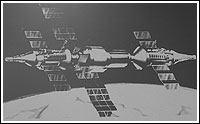
Almaz (Diamond)
Pegasus Note:UPDATE: June 01, 2008
The Almaz was the Russian counter station to the American MOL program. We will cover that in the Military section...But you can see the story of the Secret Astronauts on PBS NOVA
"Astrospies"... This is only now being released... you can extrapolate the implications
"Do they have a post office up here, can they get packages from home?"
Next Installment
Delivery of Mail and Cargo in Space